How to Choose the Right PLM Partner You Can Trust for the Next 10 Years
10 August 2026
⏱️ Reading time: 8 minutes
Why companies reach the PLM decision point
Most companies don’t wake up one morning and decide, “We need PLM.” Usually, something else comes first.
As products become more complex and variants increase, everyday work gradually becomes harder to manage. Processes that used to work start breaking down across teams. The same information appears in multiple places, and confidence in what is correct begins to fade.
At some point, the current way of working simply doesn’t scale anymore.
This is when product data management moves from being a technical concern to a business discussion. Growth may begin to slow because operations cannot keep up, teams spend more time searching for or verifying information, and the same errors or delays keep repeating.
At that stage, the question is no longer whether something needs to change but how to move forward in a way that actually works long term.
As companies start looking for ways to better manage product data across the lifecycle, PLM often comes up as a potential solution. The focus then shifts to how to evaluate and implement it in practice.
Why partner choice matters more than software features
It’s easy to compare PLM solutions as if they were just another software purchase. In reality, they are something quite different.
PLM sits at the core of how your business operates. It shapes how product information is managed, how teams collaborate, and how decisions are made across the organization. Over time, it becomes part of your operational backbone.
If the partner is not the right fit, the consequences tend to show up as dragging implementations, low adoption, and limited business impact. When things work well, the opposite is true: processes become clearer, information becomes easier to trust, and the system supports growth instead of slowing it down. That’s why the most important decision is not only what system you choose, but also who you choose to work with over time.
“Our relationship is also about far more than keeping things ticking over. Symetri is our trusted advisor. They keep us abreast of technology developments, always considering the next step in our digital transformation journey. They care about our business and keep our pace of innovation in line with the expectations our customers have of us as a leader in our field. Symetri is core to enabling Planet Platforms to embrace modern manufacturing.” Carl Geldard, CAD Manager, Planet Platforms
How to evaluate a trustworthy PLM partner
At this stage, the focus naturally shifts away from features and towards something more fundamental: can you trust this partner to deliver, and to stay with you long enough to make the investment worthwhile?
A good PLM partner should offer:
Stability and long-term commitment
A product that evolves based on real customer needs
Solid security and compliance practices
A support model that’s actually accessible
References from similar customers
In practice, this also requires strong domain understanding. Product data and processes are rarely clear or fully defined when a PLM initiative starts. Information is often scattered across systems, teams, and documents. A capable partner is able to translate this real-world complexity into structured, workable processes while balancing best practices with what is feasible in your environment.
Customer closeness makes a real difference
One thing that often gets underestimated is how closely the partner works with you in practice.
With Symetri, the idea is simple. You know who you are working with, you can reach them when needed, and your feedback is taken seriously and carried forward. Over time, this creates a more direct way of working, with shorter feedback loops and clearer communication in day-to-day collaboration.
In practice, this shows in concrete ways. You typically have a named technical contact who understands your environment and whom you can turn to when questions arise. Regular customer events bring users together and provide opportunities to discuss real use cases and ideas directly with product development. In addition, there are ongoing online discussions where new features and improvements can be explored together.
The goal is to build something that fits your environment and continues to evolve as your business develops, instead of just implementing a system.
Product development and roadmap
It is also worth looking at how the product develops over time.
With Sovelia Core PLM, development is intentionally close to customers:
The roadmap is not only visible but actively discussed
Feedback is continuously gathered and used
Product development, delivery teams, and customers work closely together
New technologies, such as AI, are part of this evolution but always introduced in a way that solves real problems, rather than adding complexity for its own sake.
Security and compliance
Security has become a basic requirement, not an extra.
Sovelia Core is developed using structured and controlled practices, supported by ISO 27001 certification and alignment with NIS2 requirements.
From a customer perspective, this should not require extra attention. You can simply trust that your data and processes remain secure and compliant.
Support in everyday use
Support is another area where the practical experience matters more than expected.
With Symetri, support is always easy to reach. It combines local teams who understand your situation with broader expertise when needed, along with direct access to people close to the product itself.
This makes it easier to resolve issues quickly and to improve things continuously, without unnecessary delays.
Where things often go wrong
Many PLM initiatives don’t struggle because of the technology itself. More often, they fail because of:
Unclear ownership
Weak governance
Unrealistic expectations
A lack of commitment at the management level
For this reason, PLM should always be approached as a shared effort between the customer and the partner. A good partner like Symetri will not simply agree to everything, but will also challenge assumptions early on to avoid problems later.
How successful PLM implementations work
A common concern is whether a PLM project will turn into a long and heavy effort. In practice, that depends less on the system and more on how the work is structured.
Successful implementations tend to follow a relatively simple logic: keep the scope focused, move forward in small steps, and let results show up early rather than waiting until the end. That's easier to sustain when the customer and partner stay in close dialogue throughout the project, rather than only checking in at major milestones.
How the implementation process typically looks
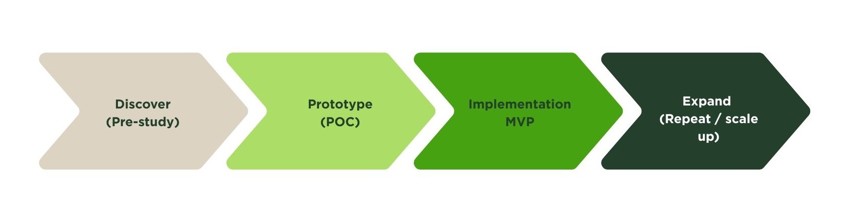
In practice, the process often moves through a few clear stages:
Discover Understanding the current situation and defining direction
Prototype Testing key ideas and assumptions
Implementation Building the first working version in iterations
Expand Developing further based on priorities
This approach makes progress more visible and manageable, avoiding the need to commit everything at once.
What to expect in practice
When the approach is structured, progress becomes steady rather than dramatic. Improvements can usually be seen relatively early, and teams learn as they go.
At the same time, it is important to stay realistic. This kind of change requires time, involvement, and the ability to make decisions.
The goal is not speed at any cost, but progress that is sustainable and continues to deliver value over time.
PLM is not just an IT project
PLM almost always affects multiple aspects of the business at once. It changes how people work, how processes are structured, and how data is managed across systems.
Because of this, it needs to be treated as a business initiative rather than a purely technical one. When that distinction is clear, the work tends to move forward more smoothly.
Common pitfalls to avoid
Some patterns repeat in less successful projects:
Trying to do everything at once
Constantly changing scope
Unclear ownership
Overly optimistic expectations
Treating PLM as purely technical
Click below for more information on implementation
How successful PLM implementations create value step by step
Successful PLM implementations rarely start with a large-scale rollout. Instead, they begin with understanding the business need, validating assumptions, and building value in manageable steps. A phased approach helps reduce risk, provides visibility throughout the process, and ensures that the solution evolves alongside business needs. It also creates opportunities to learn, adapt, and demonstrate value before expanding into new areas.
Discover: understanding the business need
The first step is a focused pre-study that looks beyond technology and explores the broader business context.
This phase helps identify:
Current challenges and pain points
Business objectives and strategic drivers
Requirements and constraints
Potential risks and dependencies
The outcome is a recommended roadmap, a high-level scope, and a clearer understanding of what success should look like. This creates the foundation for a go/no-go decision and helps ensure that stakeholders are aligned before implementation begins.
Prototype: validating assumptions early
Before significant resources are committed, key assumptions are validated through a proof of concept.
The purpose is to assess:
Technical feasibility
Integration approaches
Critical requirements
User expectations
By testing ideas early, organizations can refine requirements, identify challenges, and reduce uncertainty before moving into implementation. The result is greater confidence in both the solution and the roadmap ahead.
Implementation: building the first version that delivers value
Implementation typically focuses on a minimum viable product (MVP) rather than attempting to solve everything at once.
At this stage:
Scope and success criteria are clearly defined
Roles and responsibilities are established
The solution is developed in short iterations
Progress is continuously reviewed with stakeholders
This collaborative approach allows feedback to be incorporated throughout the project and keeps the solution aligned with business requirements.
Training, change management, and adoption are also essential parts of the process. Successful implementations focus as much on people and ways of working as on technology.
Expand: scaling based on business priorities
Once the solution is live, the work does not stop.
Many organizations begin with a focused scope and then gradually extend the solution to:
Additional business processes
New user groups
More advanced workflows
Additional integrations
New business capabilities
This allows PLM capabilities to grow in line with business priorities and organizational maturity. Ongoing measurement, roadmap reviews, and continuous improvement help ensure that value continues to increase over time.
Why this approach works
A phased implementation approach balances structure with flexibility.
Rather than trying to transform the entire organization at once, companies can:
Reduce implementation risk
Demonstrate value early
Learn and adapt along the way
Build internal confidence and adoption
One of the first benefits is often increased visibility and control. When product data is brought together into a structured environment, the organization gains a shared view of what is being designed, produced, and maintained.
Many companies describe this as a significant shift. For the first time, engineering, production, purchasing, and management can work from the same product definition rather than relying on information scattered across systems, documents, and individual knowledge.
From there, value continues to build through ongoing improvements in processes, collaboration, and decision-making.
What kind of results you can expect
The value from PLM rarely comes from a single large change. It is usually the result of many smaller improvements adding up.
While much of the value comes from incremental improvements over time, there is often a noticeable shift early in the journey. For the first time, the organization has one place that reflects what is designed, sold, and manufactured, creating a level of transparency and control that was not previously possible.
Over time, these show up as fewer errors in design and production, faster change processes, and less time spent searching for information. Visibility improves across teams, and decisions can be made with greater confidence. At the same time, compliance and traceability become easier to manage.
These improvements are typically built on a combination of having a single, reliable source of product information, clearer processes, and better connections between systems.
Taken together, they make everyday work smoother and decisions more informed.
Learn more about how to measure the value of PLM, click below.
How organizations typically measure the value of PLM
One of the challenges with PLM is that the value rarely comes from a single improvement.
Instead, it accumulates across many areas of the business. While every organization measures success differently, the most common value drivers tend to fall into five categories based on manufacturing assessments and business case evaluations.
1. Time saved across the organization
In many companies, employees spend significant time searching for information, validating product data, coordinating changes, and manually transferring information between systems.
Common improvements include:
Less time spent searching for drawings, BOMs, and documentation
Reduced manual data entry and duplication
Faster access to approved information
Fewer interruptions caused by missing or inconsistent data
Reduced dependency on individual experts
These improvements may seem small individually, but across engineering, production, purchasing, quality, and management, they can add up to substantial productivity gains.
2. Fewer errors and less rework
Many manufacturing organizations identify similar challenges during the assessment phase:
Incorrect or outdated product information
Inconsistent revisions
Missing documentation
Manual change communication
Lack of traceability across systems
When product data is controlled and managed through a shared process, companies often see reductions in rework, scrap, quality issues, and operational disruption caused by preventable errors.
3. Faster introduction of changes
As product complexity increases, change management becomes increasingly important.
Organizations often measure value through:
Shorter engineering change cycles
Faster approvals
Better traceability of decisions
Reduced coordination effort between teams
Improved visibility into change impact
When teams can understand what is changing, who is affected, and what actions are required, changes can move through the organization more predictably and with less risk.
4. Better scalability
Many companies begin exploring PLM because growth is creating operational complexity.
The value often shows up through:
Increased reuse of designs and components
Faster onboarding of new employees
Better support for product variants
More consistent processes across teams
Reduced reliance on tribal knowledge
The business outcome is improved ability to scale operations without increasing administrative effort at the same rate. Several manufacturing companies have identified this as a key strategic objective in their PLM journey.
5. Better decision-making and visibility
Perhaps the most overlooked benefit is improved visibility.
When product data is brought together into a structured environment, companies gain a shared view of:
What is being designed
What has been approved
What is currently being produced
What has been delivered
What is being maintained in the field
This creates greater transparency across the organization and allows decisions to be made based on consistent information rather than assumptions, spreadsheets, or individual knowledge.
For many organizations, this increased visibility becomes the foundation for future digitalization initiatives, including automation, sustainability reporting, advanced analytics, AI, and digital twins.
Looking beyond ROI
While financial ROI is important, many organizations find that the most significant benefits are operational.
Successful PLM initiatives typically create value through a combination of improved efficiency, fewer errors, faster changes, better collaboration, and stronger decision-making.
Rather than one dramatic improvement, value often comes from many smaller improvements working together. At the same time, there is often a noticeable early shift: for the first time, the organization gains a clear and shared view of its product information. That foundation enables the continuous improvements that follow.
How to reduce implementation risk
There are a few things that consistently make the biggest difference.
Key factors
A clear business goal
Visible support from management
Defined ownership of data, processes and decisions
A focused scope and phased approach
Close collaboration with the partner
When these elements are in place, the risk of the project becoming overly complex drops significantly.
Are you ready to move forward?
Most organizations are ready to take the next step when a few key things are clear. There needs to be a clear reason for change, and PLM should be understood as a business initiative rather than a technical upgrade. Management commitment and clear ownership are essential, as is a willingness to work closely with a partner.
If some of these areas are still unclear, that is often the right place to begin the conversation.
Next step
At this stage, the decision is no longer mainly about features but more about confidence.
If you would like to talk through your situation and explore what a realistic next step could look like:
Choosing a PLM system is a big decision, and most companies want confidence before moving forward. There’s no need to put the decision off if the real need is there, you just need to manage the possible risk in advance.
Modern manufacturing leaders need better control over product data, changes, and documentation. This executive whitepaper explains how PLM creates a single source of truth across the product lifecycle, helping companies reduce risk, improve quality, accelerate change, and make better business decisions.